Showing posts with label Ansel Adams. Show all posts

20 August 2011

Ansel Adams: How did he do it?

Susan Brannon
19 August 2011
Ansel Adams - Joshua Tree 1942 - © 2009 The Ansel Adams Publishing Rights Trust
Ansel Adams;  How did he do it?

Ansel Adams is known for his beautiful black and white nature images and for developing photography techniques in the development process of the images. 

His first camera was a Kodak No.1 Box Brownie. This camera was first rollfilm camera bearing the new brand name "Kodak", patented and introduced in 1888. It used Eastman stripping negative film. The Kodak No. 1 of 1889 resembled the Kodak, but featured a more sophisticated shutter.

I must mention however, that a good images does not come from the equipment and all the gadgets, it comes from inspiration.  Photography is an art, and your images must come from within.  Adams said, "The single most important component of a camera is the twelve inches behind it."

It is the camera that catches your imagination.  If you do not use your imagination, you will wind up with just another photograph.  Where does the word image come from?  It comes from the word "imagination". Not from lens, noise levels, sharpness, color balance.  Ansel Adams did not have PhotoShop to play around with.
Ansel Adams, went into the wilderness for months at a time.  He became inspired by what was around him.  He wanted to reflect his inspiration through his images and use his creativity.  He felt blogged down by all the commercial photography he felt forced to do for survivals sake. 

Adams made sharp images seventy years ago without worrying about how sharp his lenses were.  The lenses of the 1930's were much slower than they are today, about f/5.6.  The equipment you use, only helps to get the job done faster and easier.

What did Adams do?  He was eighteen years old taking a long trip into the wildreness, with a donkey, 100 pounds of gear and food, and a 30 pound sack of photographic equipment.  He lugged tri-pods, camera's, and portable darkrooms.

In 1915, he used his Box Brownie
In 1916 he used a Pocket Kodak and a 4x5 view
He used a Zeiss Millifles
a 6-1/2 x 8 1/2 glass plate camera
4 x 5 camera
Hassleblands
35mm (he called miniture)
Polaroid

Adams said, "If we had very heavy cameras we simply didn't go so far or take so many pictures. Knowing what I know now, any photographer worth his salt could make some beautiful things with pinhole cameras."

He like using a large format camera 8x10.  His favorite medium format camera was a 6x6.  For the last 20 years of his life, he used a Hasselblad medium format, which he created the famous "Mood and Half Dome" image.

In his portrait image, he is holding a Hasselblad 500 C/M

Ansel Adams - Saguaro Cactus, Sunrise, Arizona 1946
Other than being inspired an having large or medium format camera's what did he do?
Adams liked to control the depth of field, by adjusting the film plane and the lens, with the relationships of objects in the frame, with tilt and rise and fall movements.  Doing these things, he was able to alter the perspective to what he desired, controlling rise movements or increasing depth of field by making the lens standard tilt down.

Adams tilted the lens standard of his view camera in order to extend his depth of field, close to infinity.  1) by stopping his view camera down as far as he could and 2) using the camera's movements to take advantage of the Scheimpflug theory. (shift horizontally to make perfect parallel lines)

Typical digital lenses cannot achieve the same perspective as a view camera because of the physics involved.  When the film plan and the lens plane are rigid, we can have a measure of control over the depth of field and perspective, but we are limited.

You can tilt the camera, with a regular lens on it and the parallel lines converge.  Threes and other elements in the frame can look like they are falling backward.  This is the rise and fall movements.

You can purchase tilt lenses, but you will need to use your camera on total manual.  Forget the auto focus and sensors.  The tilting, stretches out the depth of field so you can frame easier without distortion.

Adams developed all his own film, using a small space in his parents home, and while in the field.  He first used matte and changed to glossy paper to increase the tonal values.  He spoke often about using the natural light and small apertures with long exposures.  Adams also suggested to "visualize" each image before taking it.  This means, taking your time, walking around looking at things from different points of view.

Adams, was a promoter of "pure photography" "Pure photography is defined as possessing no qualities of technique, composition or idea, derivative of any other art form.' Soft focus lenses were prohibited, but in Adams earlier work of the Monolith, he used a strong red filter to create a black sky.  Adams mounted a camera platform on the top of his station wagon, to get a better vantage point over the immediate foreground and a better angle for expansive backgrounds.  Most of his images from 1943 forward were made from the roof of his car.

Adams developed the "zone System" of controlling and relating exposure and development, enabling photographers to creatively visualize an image and produce a photograph that matched and expressed that visualization.

Ansel Adams Technical Books:
    * Making a Photograph, 1935.
    * Camera and Lens: The Creative Approach, 1948. ISBN 0-8212-0716-4
    * The Negative: Exposure and Development, 1948. ISBN 0-8212-0717-2
    * The Print: Contact Printing and Enlarging, 1950. ISBN 0-8212-0718-0
    * Natural Light Photography, 1952. ISBN 0-8212-0719-9
    * Artificial Light Photography, 1956. ISBN 0-8212-0720-2
    * Examples: The Making of 40 Photographs, 1983. ISBN 0-8212-1750-X
    * The Camera, 1995. ISBN 0-8212-2184-1
    * The Negative, 1995. ISBN 0-8212-2186-8
    * The Print, 1995. ISBN 0-8212-2187-6 (Wikipedia)

18 August 2011

Kodak No.1 Box Brownie

Kodak No.1 Box Brownie
Susan Brannon
18 August 2011
The Kodak No.1 Box Brownie was Ansel Adams first camera.
This camera was first rollfilm camera bearing the new brand name "Kodak", patented and introduced in 1888. It used Eastman stripping negative film. The Kodak No. 1 of 1889 resembled the Kodak, but featured a more sophisticated shutter.  It was discontinued in 1916.

The cost? $1!

In use, the shutter was set by pulling a string; the camera was sighted by looking along a V-shape on the top of the camera. The shutter was tripped by pressing a button on the camera's side. After exposure, the key was used to wind the film to the next frame. The film moved past a shaft, rotating it, which caused a pointer visible on the top of the camera to rotate, so the photographer could be sure of advancing the correct amount of film.

Once one hundred pictures had been taken, the user sent the whole camera back to Kodak for film processing and reloading - at a cost of $10[1]. A hundred round negatives with a diameter of 65mm came from each roll of Eastman American Film. The round image was a design decision, partly as a way of ensuring that the photographer didn't have to hold the camera exactly level with the horizon, and partly to compensate for the poor image quality at the corners of the image. These first Kodak cameras were designed by George Eastman in collaboration with a cabinetmaker, Frank A. Brownell, who set up the production line at Eastman's factory. They are beautifully built, with box joints and strong leather covering.
Of course, those were the days when a photographer had to carry all kinds of equipment along with him and develop his own film.  I still like the medium format images the best for landscape, portraits and documentary photography.  I still like to develop my own film and yes, I have used the dodge technique that Adam's designed.  They sure do help the clouds come out fabulous!
Just for fun, I decided to look and see if I can find one of these boxes and how much are they now?
Well, I found one on E-Bay for 33 dollars, the person said that it was in "mint condition"
that was the only one that I found.  Here you can find the history and development of the Kodak cameras.
If you find one of these camera's at a garage sale, look to make sure that it does not leak light. The No.1 uses 620 film which may be hard to get, but if you go to a professional camera store they can find it for you.  You may be able to find the film online.  The images are soft with a nostalgic feel to it! They will not look like digital images.  Here is a link on how to use a Brownie Box!  Where to get manuals and more the brownie website.

17 August 2011

Ansel Adams: Georgia O'Keeffe and Orville Cox

Ansel Adams - Georgia O'Keeffe and Orville Cox
Susan Brannon
17 August 2011
Georgia O'Keeffe and Orville Cox- Canyon de Chelly National Monument, 1937 It was unusual in Adam's photography to include human beings in his images.  When he did portraits, I feel that they were exquisite as reflected in this image of Georgia O'Keefe and Orville Cox.  I must say that I really like this image, and it is one of my favorites.  I adore the expression on Georgia O'Keeffe's face! The sky and clouds are high above their heads, their expressions are detailed and the lighting spectacular. 
 The story behind the image:
Orville Cox was the wrangler at Ghost Range and the guide on a several week trip taken by O'Keefe, Adams and others.  One interesting point of the photo is that it was taken with a 35 mm camera.

In September, 1937, David Hunter McAlpin organized a month-long camping trip throughout the Southwest with his friends Georgia O'Keeffe and photographer Ansel Adams. The result of this camping trip, a unique and rare set of photographic proofs made by Adams and later given to his friend McAlpin.

The group included McAlpin's cousins, Godfrey and Helen Rockefeller, and Ghost Ranch head wrangler Orville Cox, who would be an interpreter and guide. Adams brought three cameras, two view cameras and a 35mm Contax. O'Keeffe filled a station wagon with painting supplies. The group was delayed for two weeks in Abiquiu, at the Ghost Ranch while O'Keeffe finished some work. Then they hit the road.

"Everyone knows the classic Adams photos of highly shadowed desert landscapes. O'Keeffe's fascination with the light, landforms, and artifacts of the Southwest is also noted," says Curator of the Exhibition Stephen Jareckie. "These proofs show that landscape - stark, isolated, magnificent - just as these two artists saw it. For us to see these pictures, the majority of which have never been exhibited before, is to glimpse a place that was crucial and inspirational to two major American artists."

"What's important about these photographs is both documentary and artistic. These are real Adams pictures. Though they're casual, and were clearly done on the spot, they still retain Adams's customary pictorial structure," says Jareckie. "But these aren't just landscape pictures. There are also numerous snapshots of the camping group, which include revealing portraits of Georgia O'Keeffe that have not been published."  

After the death of Sarah Sage McAlpin in 2001 her heirs discovered a box containing nearly 300 small-format prints of photographs by Ansel Adams taken on this trip. Some of the images were probably as close as Adams came to taking "snapshots," but those displayed here are carefully prepared "proofs." In a number of cases Adams went on to make larger-format photographs of the same or slightly-altered views. The Ansel Adams Foundation has contact-sheets and negatives for many, if not all of these images, but in most cases these smaller images appear to be the only prints of these photos ever made by Adams himself.

16 August 2011

Ansel Adams: Thunderstorm Espanola Valley

Ansel Adams - Thunderstorm Espanola Valley © The Ansel Adams Publishing Rights Trust
This images cannot be printed or reproduced in any way. The use of the photograph is limited to viewing in the context of this web site.
15 August 2011
Thunderstorm, Espanola  Valley, 1961 - I could not find much information on this image, but for me, being a New Mexican, this image shows the intensity of the storms.  Form this location, you can see the storm coming from miles away because of the vast horizon in New Mexico, and the big sky that looms over head.  The light in this image is wonderful because you can see the suns reflections on the clouds and a bit of light falling on the hill.  This is one of his later images, and by then he had hiked around New Mexico since the 1940's.

In 1941 the Secretary of the Interior, Harold Ickes, hired Adams to photograph lands and Native Americans under his department's jurisdiction. Adams intended to make some thirty-six photographic murals to hang on the walls of the Department of the Interior. He hoped that his powerful images hung in an emotionally progressive sequence would positively influence congressmen, lobbyists, and government officials. His job description read, "Photographic Muralist, Grade FCS-19, " and his contract was effective from Oct. 14, 1941 to July 2, 1942. At the same time Adams was saddled with his duties as Vice-Chairman of the Board of Advisors of the Department of Photography at New York's Museum of Modern Art which he had helped found in 1940. Thus, he was unable to start the mural project until June of 1942 when he headed west to make negatives. He planned to photograph in Colorado, Yellowstone, the Tetons, Glacier National Park, Mount Rainier and Crater Lake. Given his late start and the fact that World War II prevented his contract from being renewed, he made a number of now classic photographs, but never finished the mural project for the Department of the Interior.
I am sure that the New Mexican light had a lot to do with Ansel Adams returning to capture images.  There is a magic in our light and landscape that seems to offer inspiration to artists from around the world.


15 August 2011

Ansel Adams: Church Doors Taos Pueblo

Church Taos Pueblo - 1942 National Archives, Department of Interior
Church Taos Pueblo - 1942 National Archives, Department of Interior (Angle 2)
Susan Brannon
15 August 2011

Church Taos Pueblo-Doors, and Angle 2 -Ansel Adams-  1942.   This is a good place for photographing in black and white because of the light. In the first image, the walls line up symmetrically to the closed door of the church.  In the second image, most likely taken at the same time, the church geometric s stand out and the door cannot be seen.  A good photo, is knowing where to stand.  We can see that Adam's shot the church from at least two angles.  Which one do you like best?  Both viewpoints have been made into posters and sold as prints all over the world.

14 August 2011

Ansel Adams: Acoma Pueblo

Ansel Adams - Acoma Pueblo - Public Domain Printed 1941
Susan Brannon
13 August 2011
Acoma Pueblo- 1933, Public Domain Printed 1941.  Ansel Adams took this image while he was working for the Department of Interior.  I believe that the photograph was taken just after a storm, because the pool of water on the dry Acoma mesa is an unusual scene.  The image is now a part of the National Archives.  The pueblo is a U.S. National Historic Landmark and Registered of Historic Places.  Adams was drawn to the stark, elemental beauty of the natural and built environment. In this image, Adam's focused entirely on shape, form and the interplay of dark and light.  The large, placid, oval pool of water in the foreground is balanced against a series of adobe buildings in the background.  The middle is a transitional zone, that is created by the reflection of the architecture in the pool.  The image transforms the cultural and political realities of the Pueblo into a quiet realm of timeless beauty.

13 August 2011

Ansel Adams: Saint Francis Church, Ranchos de Taos

Saint Francis Church, Ranchos de Taos, New Mexico, c. 1929-© The Ansel Adams Publishing Rights Trust This image is copyrighted by The Ansel Adams Publishing Rights Trust and cannot be printed or reproduced in any way. The use of the photograph is limited to viewing in the context of this web site.
Susan Brannon
13 August 2011
Saint Francis Church, Ranchos de Taos, New Mexico, c. 1929 - When he first saw the church, Adams was impressed by it's "magnificent form" and its "rigorous and simple design and structure." The photograph of this church was shot from the rear, which was the angle that Adams thought made it "one of the great architectural monuments of America." He wrote in Elements, "it is not really large, but it appears immense. The forms are fully functional; the massive rear buttress and the secondary buttress to the left are organically related to the basic masses of adobe, and all together seem an outcropping of the earth rather than merely an object constructed upon it."

Though this church is not actually in the Pueblo, it held significance for the entire area. Constructed in 1776, it is in the little Mexican American settlement of Ranchos de Taos a few miles south of the Pueblo. It had been interpreted by many painters and photographers, and Adams said he could not resist the challenge.

Adams wrote in Elements, "We should never deny the power of intuition or hesitate to follow its revelations... It is essential that the artist trust the mechanisms of both intellect and creative vision. The conscious introspective critical attitude has no place in the luminous moments of creative expression, but should be reserved for later, when the work is complete." He stated, "I seemed to know precisely the square yard of earth on which to place my tripod." He said, "Some intuitive thrust made this picture possible."

Adams stated in Elements that "this image is an experience in light." He described how he had used yellow and red filters before in many images in special high-altitude light of the Southwest. "But on this occasion some gentle angel whispered 'no filter' and I obeyed." Taking the shot with no filter allowed the blue sky to appear quite light, and the shadows were softened... A darker sky would have depreciated the feeling of light." He asks a good question himself: "What mechanism of the eye and mind selects patterns and relationships in an unfamiliar world about us and composes them as expressive images?" He doesn't claim to have the answers.

    * Camera: 6 1/2 X 8 1/2 Korona View
    * Lens: 8 1/2 inch Tessar-type lens
    * Film: orhochromatic (sensitive only to blue and green light)
    * Filter: none
    * Paper: Dassonville Charcoal Black on mildly textured rag paper of highest quality Developer Amidol

Information taken from: HHMA

12 August 2011

Ansel Adams: Moonrise Hernandez

Ansel Adams - Moonrise Hernandez
Susan Brannon
 12 August 2011
Moonrise Hernandez - 4:05 P.M. on October 31, 1941 Moonrise is one of Adam's most popular images. Why is that?  Do you notice the white clouds, the moon, or the white gravestones first? Do you notice how the photograph is divided according to the "Rule of Thirds?"
Many artists believe it is boring to look at images that are absolutely symmetrical, with images divided exactly in half. In Moonrise, Adams has stimulated our eye by offering three layers, each with a different tone: the black sky, the white clouds, and the gray landscape. Adams made an interesting composition, which became very popular. It "combined serendipity and immediate technical recall." Serendipity means lucky chance. He "felt at the time it was an exceptional image" and when he took it, he felt "an almost prophetic sense of satisfaction." The scene has changed, there are still some of the same features, but the road is wider and busier.  There are more modern buildings, but the graveyard is still there.  When he was a young creative photographer, his original prints sold for $10, and in the 1960s for $50 - $100. The price for a print of Moonrise in the early 1970s was $500. Then the value of the creative photographs of Ansel Adams skyrocketed. At an auction in 1981, the sale of Moonrise set a record price for a photograph - $71,500! Ansel Adams was returning to Santa Fe, New Mexico after a discouraging day of photography. From the highway he glanced left and "saw an extraordinary situation - an inevitable photograph! I almost ditched the car and rushed to set up my 8 X 10" camera. I was yelling to my companions to bring me things from the car…I had a clear visualization of the image I wanted but…I could not find my exposure meter! The situation was desperate: the low sun was trailing the edge of clouds in the west, and shadow would soon dim the white crosses." He felt at a loss to guess the correct exposure, but suddenly realized he knew the luminance of the moon and quickly took the shot."

"
I was at a loss with the subject luminance values, and I confess I was thinking about bracketing several exposures, when I suddenly realized that I knew the luminance of the moon – 250 c/ft2. Using the Exposure Formula, I placed this luminance on Zone VII; 60 c/ft2 therefore fell on Zone V, and the exposure with the filter factor o 3x was about 1 second at f/32 with ASA 64 film. I had no idea what the value of the foreground was, but I hoped it barely fell within the exposure scale. Not wanting to take chances, I indicated a water-bath development for the negative.
Realizing as I released the shutter that I had an unusual photograph which deserved a duplicate negative, I swiftly reversed the film holder, but as I pulled the darkslide the sunlight passed from the white crosses; I was a few seconds too late!”
Paraphrase of John Sexton, Ansel's technical assistant from 1979 to 1982
In October 1941 Ansel Adams was 39 years old, probably in peak physical shape and certainly at or near the height of his field photography. He was well practiced in every motion, and the time that it takes to make a duplicate negative, to replace the slide, reverse the film holder, remove the slide and cock the shutter is less than 3 seconds. Given that the initial exposure was 1 second and the decision to make a duplicate negative occurred then, Ansel was very, very close to missing that image. It is a testament to his skills that we are able to appreciate it today.”

  • Camera: 8 X 10 view camera
  • Lens: Cooke triple convertible lens.
  • Light meter: lost!
  • Film: Speed: ASA 64
  • Filter: Wratten No. 15 (G) filter
  • Exposure: 1 second at f/32.
  • Development: dilute D-23 and ten developer to water sequences.
    Years later - refixed, washed the negative, and treated the lower section with a dilute solution of Kodak IN-5 intensifier.

11 August 2011

Ansel Adams: Aspens

Ansel Adams -Aspens  ©2008 Ansel Adams Publishing Rights Trust
Ansel Adams - Aspens (no title)
Ansel Adams -  Aspens Northern New Mexico © The Ansel Adams Publishing Rights Trust
These images are copyrighted by The Ansel Adams Publishing Rights Trust and cannot be printed or reproduced in any way. The use of the photograph is limited to viewing in the context of this web site.
11 August 2011
Aspens- I believe that the second image was taken in Northern New Mexico in 1958.  Adams took many aspen images while he was there, and with this photo, the lighting looks like it was taken at the same time as the known and famous image that Adams is titled, "Aspens of Northern New Mexico"  I could not find the copyright on this one, nor a title, but I really like it. I chose this image because of the geometric of the trees and the lighting reflecting the fullness of the trees.  The first image shows a mastery of a vast spectrum of shadow and luminous light within the simplicity of black and white. The single lit leading tree with many other trees standing behind it.  
In this set of images, you can see how Adam's walked around to capture different views of the same subject.  He used the natural lighting, and it could have been taken either at sunrise, or near sunset because of the light on the trees.


10 August 2011

Ansel Adams: Roots, Foster Gardens, Honolulu

Ansel Adams - Roots, Foster Gardens, Honolulu © 2004 by the Trustees of the Ansel Adams Publishing Rights Trust. Courtesy of George Eastman House.
Susan Brannon
10 August 2011
Roots, Foster Gardens, Honolulu- 1948.  This is one of Adams images that is refined with close up detail rather than the vast images of landscape. He worked with texture and abstract imagery in this image. The roots, draw your eyes to find the trunk of the tree.
Adams once said, "To photograph truthfully and effectively is to see beneath the surfaces and record the qualities of nature and humanity, which live or are latent in all things."

09 August 2011

Ansel Adams:Dunes, Oceano, California

Susan Brannon
09 August 2011
Ansel Adams -Dunes, Oceano, California
Susan Brannon
Dunes, Oceano, California, 1963. The shadows in the sand dunes reflect the incredible patterns of the hills made from the timeless winds in the dunes.  At first I thought this image was of the white sands in New Mexico, however, sand dunes are sand dunes and this image makes me want to jump in and leave my footprint!

08 August 2011

Ansel Adams: Moon and half Dome

Ansel Adams-Moon and Half Dome
Susan Brannon
8th August 2011
Moon and Half Dome - This image was taken at Yosemite National Park in 1963. Adams reahed for his Hasselbland and took his camera and tripod into the meadow looking for the spot where the elements come together; the full moon, the valley and the silhouette of Washington Column.

This image became a classic and one of the most love black and white pictures made. To make the same scene, you need to have the light, the moon and the shadow all in place.  Adams made this shot in December around Christmas time, if you want to go and try it yourself!

06 August 2011

Ansel Adams: Moonrise

This image is copyrighted and is for the sole use of viewing on this website

Susan Brannon
6 August 2011
Moonrise, Hernadez, New Mexico - Was one of his most famous.  The ititial publication of Moonrise was in U.S. Camera 1943 annual.  For nearly 40 years, Adams re-interpreted the image using the latest darkroom equipment at his disposal, making over 1,300 unique prints, mostly in 16" x 20" format.  Many of the prints were made in the 1970's giving him more freedom from the commercial projects that seemed to blog him down.  He took this shot after the sun had gone down and the light on the crosses were rapidly fading and he could not find his exposure meter. He remembered the luminance of the moon, and used it to calculate the proper exposure.  The exposure was underexposed, and the highlights in the clouds were quite dense.  He found the negative difficult to print.  The total value of this print exceeds 25,000.00 with the highest price for a singe print reached $609,600 at an auction in NY in 2006.  He made this image on November 1, 1941.

Some of Adams images are owned by the U.S. Government because he worked for  the Department of the Interior.  However, it was his day off when he took Moonrise, so he had full ownership of the negative.

05 August 2011

Ansel Adams: Autumn Moon

Ansel Adams - Autumn Moon
Susan Brannon
9 August 2011
Autumn Moon - 1948, the images was taken from Glacier Point at Yosemite National park on September 15 at around 7:03 pm. Adams is famous for recording details in this image.  It is said that the full moon arching high in the northern hemisphere only occurs on every lunar Metonic cycle. The dates to be able to get this exact moon will be in 19 year cycles, 1967, 1986,2005,2024.  Sorry folks, you will have to wait until 2024 to recreate this exact image.

04 August 2011

Ansel Adams

Susan Brannon
4th August 2011
Ansel Adams a Biography 

Ansel Adams has been the environmental legendary photographer who captured Americas beauty through the lens.  He is known for his black and white photographs that resound with shadows and light.  In my opinion, he has been one of the best photographers in our American history.

He was born in San Francisco on February 20, 1902 and passed on in April 22, 1984. He was a traveler and environmentalist who had a keen passion for nature. It is assumed that Ansel Adams suffered from dylexia, because he had problems fitting in at school.  Some others feel that he may have had ADHA, hyperactive disorder.  His father decided to tutor him at home, and earned a diploma completing the 8th grade from Mrs. Kate M. Wilkins Private School.

He would wolk in nature in his childhood in the wilds near the Golden gate bridge or hiking the dunes along Lobos Creek and off to Bakers Beach.  Later in life, he set out through America.

At twelve years old, Ansel Adams taught himself to play the piano and became his primary occupation.  It could be that the training and discipline required to learn the piano influenced his view of photography.

His first camera was the Kodak No. 1 Box Brownie that his parents bought him.  He would take the camera with him during his hikes and spent the first four summers from 1919, in Yosemite Valley as the "keeper" of the Sierra Clubs, LeConte Memorial Lodge.


The Sierra Club contributed to Ansel Adams success as a photographer because he first published photographs and writings in the club's 1922 Bulletin, and in 1928 he had his first one man exhibition in San Francisco.

in the late 1920's, the Sierra Club would offer month long trips in the Sierra Nevada, where the participants hiked each day to a new campsite, using mules, packers, and cooks.  Adams, was the photographer of the outings and he soon realized that he could earn enough money to survive.  By 1934, Adams was elected to the club's board of directors and was already established as both artist and director of the Sierra Nevada.

Ansel Adams met photographer, Paul Strand in the 1930's and influenced his work from "pictorial style" to "straight photography", using the clarity of the lens.  Adams developed the development techniques of "burning" and "dodging" as well as the "zone system" to adjust the tonality of the images.  In 1952 Adams was one of the founders of the magazine Aperture, which was intended as a serious journal of photography showcasing its best practitioners and newest innovations.

Although Adams was gaining in popularity, in the 1930's he still seemed to have difficulty with financial pressures. He was busy, as a commercial photographer, but the clients took control.  He worked for National Park Service, Kodak, Zeiss, IBM, AT&T, Life, Fortune and the Arizona Highways magazines, shooting portraits to catalogues.  He was loosing his track in photography because he was swamped with commercial work for practical reasons.

Adams was good with technical matters in photography as consulted companies like Weston and Strand, Polaroid, and Hasselbland.  Ansel Adams was a activist of the cause of the wilderness and environment.  Adams images became an icon of wild America.  His images are no "realistic" of nature, but they have an intensification and purification of the experience of natural beauty.  (Ansel Adams)
His compelling images came from inspiration!

Related Articles:
Henri Cartie'r-Bresson (article)
Henri Cartie'r Bresson (Images)

25 July 2011

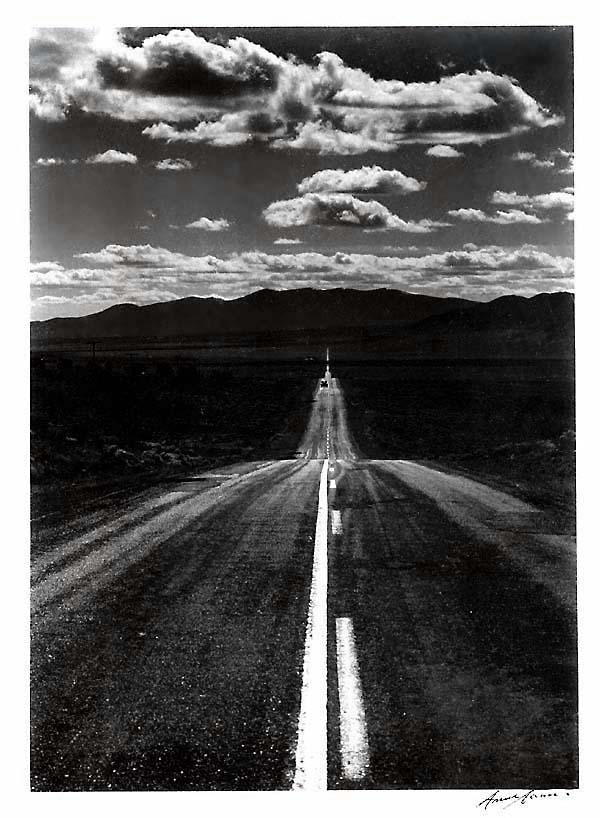
Road, Nevada Desert

Ansel Adams - Road, Nevada Desert - National Archives, Dept. of Interior
Susan Brannon
9 August, 2011
Road, Nevada Desert- 1960 This is a good example on perspective balance, again, plays a part. the pitch black desert is separated from the rough sky by the horizon. contrast obviously plays a role as well. the road running directly through the middle of the shot for what seems to be forever.  To develop the images of the clouds, Adam's must have "dodged and burned" the sky area.