


27 November 2011
Dorothea Langue: Documentary Photography or Photojournalism?“One should really use the camera as though tomorrow you'd be stricken blind.”
“Pick a theme and work it to exhaustion... the subject must be something you truly love or truly hate.”
Dorothea Langue
Dorothea Langue is known for her work during the great depression era while working for the Farm Security. She was a documentary and photojournalist photographer. She was born on May 26, 1895 and dies October 11, 1965. She studied photography at Columbia University and apprenticed in several New York photography studios, later she moved to San Francisco and opened a portrait studio. During the depression, she went from her studio and watching the people in the street below her, to photographing the people in the street photographing the unemployed and homeless, “combing those who paid and those who did not”. Later, she toured the field with her husband who was gathering economic data for the government.
Many of the images she took became public domain because of her work for the Farm Security. Some of her images were “off hours” and became copyrighted to her name. Her images were to bolster support for the establishment of migrant camps.
Dorothea used a 4 x 5 Graflex D camera for most of her shots. She felt that the camera, “Teaches people how to see without a camera” Langue worked a lot by using her instincts, “to find out later how right your instincts were, if you followed all the influences that were brought to bear on you while you were working in a region.…It did happen more than once that we unearthed and discovered what had been either neglected, or not known, in various parts of the country, things that no one else seemed to have observed in particular, yet things that were too important not to make a point of.”
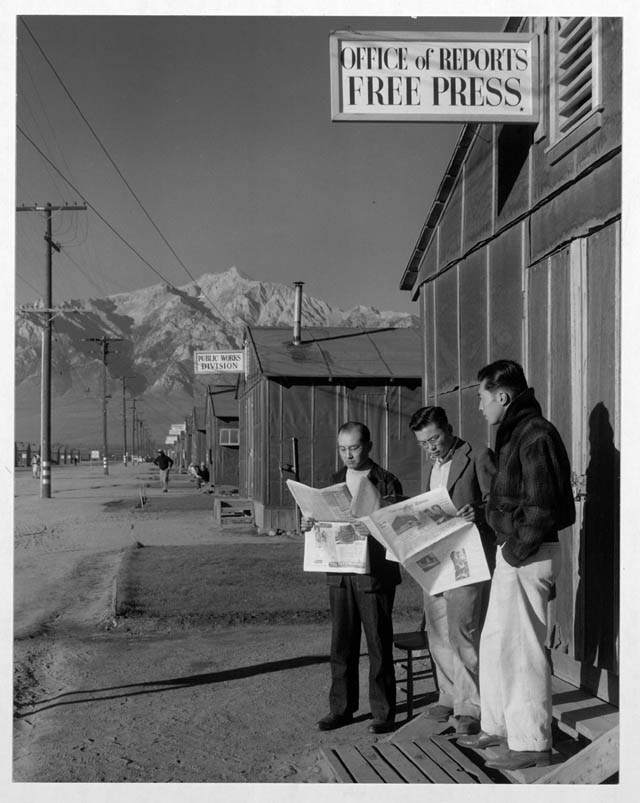
In the 1940’s she documented the forced relocation of Japanese Americans to internment camps. In the 1950’s and 1960’s she produced photographic essays on Ireland, Asia, Egypt and the post-war boom in California.
Dorothea Langue interacted with her subjects, in order to capture a realistic, honest and truthful image. Langue was a patient photographer, sticking around, talking to the people, asking them questions, “where are you from?” remaining there, and sitting on the ground with them. She listened to the people that she photographed and tried to remember what they said so later when she went to her car, she could write down what they said. She would use their quotes with the images captions, she liked “using the words that came directly from the people’s mouths”. By the end of 1939 she had set the standard for photography captions.
While she was working for the government, they wanted images of a certain type, framing the subject to tell the story, while in the darkroom removing the “negatives” like brushing away a thumb, lightening some areas, darkening others and moving a cow skull to show evidence of a drought.
Dorothea Langue had a somewhat mystical approach to the problem of authenticity. She believed that through her camera she could see into the psyches of her subjects, and that by penetrating beneath a surface she could get at a truth that was deeper, more truthful, than were facts available at first glance. Taken literally, her notion that she had a kind of X- ray vision seems to absurd, but is a way of saying something about the role of documentary photography.
The debate about authenticity and objectivity may never be solved. It continues today whether the subject is literature or history or journalism or photography. Unfortunately today many people continue to worry more about whether a photographer has asked a subject to take off his hat or look toward her child than about whether the photographer’s interpretation illuminates truths heretofore hidden. Some of this concern comes from a confusion of documentary photography with photojournalism, some from increased public awareness of how easily and undetectably images can be altered.
We need to get straight what documentary photography has been and is: overwhelmingly often an art form inspired by concern for social justice and eagerness to participate in social change. It aims to see and show beneath the common-sense assumptions that so often prevent us from seeing the actual relationships that create both human and ecological erosion.
Related Articles:
Comparative Essay: The Great Depression/The Current Crisis
Ansel Adams: How Did He Do It?
Ansel Adams: Georgia O'Keeffe and Orville Cox
Documentary Photography: Lesson 1
Documentary Photography: Lesson 2 Altering Images, How Far Can We Go?
Photojournalism Visual Lies
Street Photography Tips
What is the Difference Between Street Photography and Documentary Photography?
Ethics and Credibility




 Posts
Posts


